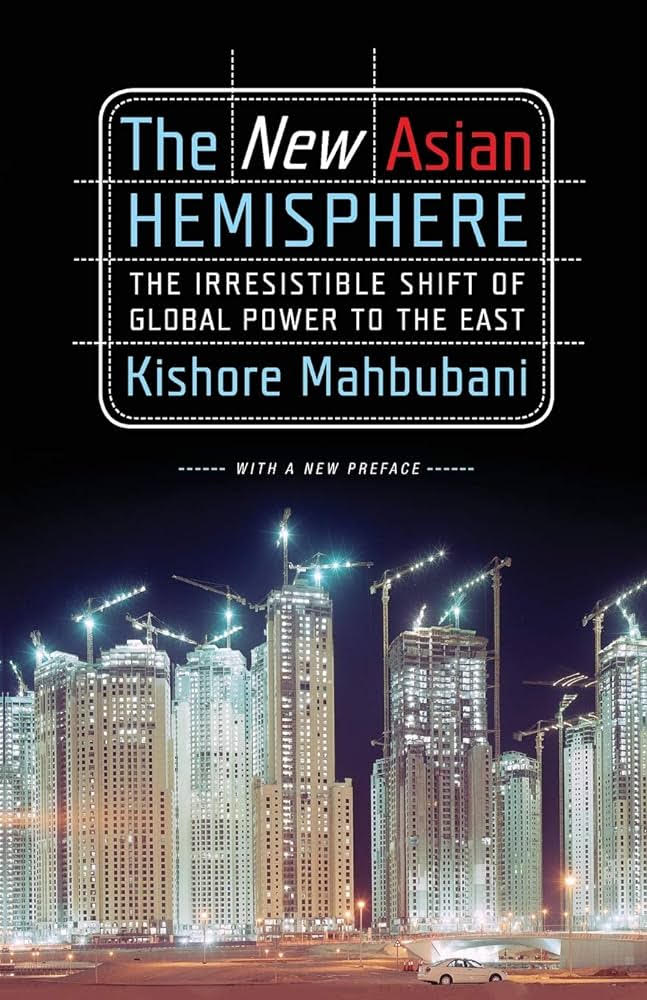
New Asian Hemisphere: The Irresistible Shift of Global Power to the East
| Advance Praise Book Reviews Op-eds by Kishore Mahbubani List of Countries and Publishers | ||
For centuries, the Asians (Chinese, Indians, Muslims, and others) have been bystanders in world history. Now they are ready to become co-drivers.Asians have finally understood, absorbed, and implemented Western best practices in many areas: from free-market economics to modern science and technology, from meritocracy to rule of law. They have also become innovative in their own way, creating new patterns of cooperation not seen in the West.Will the West resist the rise of Asia? The good news is that Asia wants to replicate, not dominate, the West. For a happy outcome to emerge, the West must gracefully give up its domination of global institutions, from the IMF to the World Bank, from the G7 to the UN Security Council.History teaches that tensions and conflicts are more likely when new powers emerge. This, too, may happen. But they can be avoided if the world accepts the key principles for a new global partnership spelled out in The New Asian Hemisphere.Excerpt of this BookThe need to develop a better understanding of our world has never been greater. We are now entering one of the most plastic moments of world history. The decisions we make today could influence the course of the twenty-first century. But it is clear that the worldviews of the leading Western minds are trapped in the previous centuries. These minds cannot even conceive of the possibility that they may have to change these worldviews to understand the new world. Unless they do, we could make disastrous decisions.The best illustration of a disastrous decision is the decision by the U.S. and UK to invade Iraq in March 2003. The Americans and British had benign intentions: to free the Iraqi people from despotic rule and to rid the world of a dangerous man, Saddam Hussein. Neither Bush nor Blair had malevolent intentions. Yet, the mental maps that they brought to understand Iraq were mired in one cultural context: the Western mindset. Many Americans actually believed that invading American troops would be welcomed with petals thrown on the streets by happy Iraqis. The idea that any Islamic country would welcome western military boots on its soil defies belief. The invasion and especially the occupation of Iraq will go down as one of the most botched operations in human history. Yet even if it had been well-executed, it was doomed to failure. In 1920, as secretary for war and air, Winston Churchill could use poison gas to quell the rebellion of Kurds and Arabs in British-occupied Iraq. He said, "I am strongly in favor of using poisoned gas against uncivilized tribes." If Blair had tried the same in 2005, he would have been crucified. The world has moved on from this era. Sadly, Western mindsets have not moved on.A Note from Kishore MahbubaniFor over two decades, I have lived the life of a nomadic intellectual, absorbing ideas at great intellectual watering holes, like Davos and Aspen, Ditchley and Pocantico. Initially, I was overwhelmed by the confidence and energy of Western intellectuals. They had sharp minds, always producing new insights as they spoke.It has come as a huge personal shock for me to see this same group of Western intellectuals now becoming totally blind to emerging new realities. At a time of rapid change, these Western minds remain complacent and smug. I tried to puncture this smugness in my speeches and columns. Sadly, I failed. They could not see that we are moving from a monocivilizational world to a multi-civilizational world.These failures taught me a lesson. The only way to persuade the West of the need to change mindsets was to try and develop an alternative weltanschauung. That is the ambitious goal of this book. If we do not wake the West up from its intellectual complacency, we are headed for trouble.Op-eds by Kishore Mahbubani
Ringing in the Asian century
Asia’s geopolitical competence List of Countries and PublishersChinese (Simplified) edition: 新亚洲半球:势不可挡全球权力东移, Beijing Reader's Cultural & Arts Co. Ltd., China Chinese (Traditional) edition: 亞半球大國崛起:亞洲強權再起的衝擊與挑戰, CommonWealth Magazine, Taiwan French edition: Le défi asiatique, Fayard, France German edition: Die Ruckkehr Asiens: Das Ende der westlichen Dominanz, Propyläen Verlag, Germany Italian edition: Nuovo emisfero asiatico: l'irresistibile ascesa dell'est, Università Bocconi, Italy Japanese edition: 「アジア半球」が世界を動かす, Nikkei BP Publishing Centre, Inc., Japan Korean edition: 헬로아시아: 글로벌 경제의 재탄생, Electronic Newspaper, Korea Arabic edition: نصف الكرة الآسيوي الجديد, Egyptian National Center for Translation, Egypt Reviews of this Book
De-Westernisation at full trot - Book review: The New Asian Hemisphere
Book Review: The New Asian Hemisphere
Review of The New Asian Hemisphere, The Irresistible Shift of Global Power to the East
The New Asian Hemisphere Rivals How the Power Struggle Between China, India and Japan will Shape Our Next Decade
Insights into Global Power Balances
East is the New West
We Are All Asians Now
Asia Pushes, West Resists
Het Western zit op slot
India, China can’t have Too Much Inequality
Asia Rising – But Not at the Expense of the West
The rise of Asian nations
Mapping A New World
Eye on the new Orient
How America can cope with the rise of Asia
Books: Eastern euphoria
A Rising in the East
South Asian Journalists Association radio
interview
Clinton, McCain, Obama Needn't Fear Asia's Rise
The Great Eastern Promise
One Face, Another Colour
The Future of Asia: Eastern Approaches
Kishore Mahbubani's New Book Addresses Shift of
Global Power
A Review by Susan Froetschel Advance Praise for The New Asian Hemisphere"In The New Asian Hemisphere, Kishore Mahbubani has given us a very powerful account of the world seen through Asian eyes, and has shown the global relevance of that penetrating vision. The book is both insightful and delightfully combative as well as fun to read."Amartya Sen "There is no more thoughtful observer of Asia, the United States, and their interaction than Kishore Mahbubani. Having written about Asia, then the United States he has produced a book on their interaction that should be read by anyone who hopes to or will shape US foreign policy over the next decade. And it should be read by anyone in Asia who hopes to understand or influence that policy...The rise of Asia and all that follows it will be the dominant story in history books written 300 years from now with the Cold War and rise of Islam as secondary stories."Lawrence H Summers "Kishore Mahbubani is a historian of ideas whose starting point is the present and whose horizon is a visible, startling future. This remarkable book is a fact-based projection of Asia's rising trajectory. The West has been synonymous with modernity for perhaps the last three centuries. Asia is the New Modern. Vision and clarity make this book a sparkling history of the Age of Asia."M J Akbar "The Western, particularly the American, response to the rise of Asia has been petulant, degenerating into protectionism and panic. Japan-bashing of the 1980s was succeeded by India-bashing over outsourcing in the 1990s and now we have China-bashing in the 2000s. Mahbubani, one of the most perceptive and influential Asian intellectuals today, shows the folly of these reactions and the wisdom of applauding and working with the reality of Asia's remarkable success. His splendid book must be read by every Western policymaker; it is a tour de force."Jagdish Bhagwati "An incisive analysis of the long-term implications of the ongoing shift in the global center of gravity. The new Asian hemisphere offers warnings and lessons that America should digest if it is to continue playing a preeminent global role – and the advice comes from a friend of America with an intimate understanding of Asian realities."Zbigniew Brzezinski
"Kishore Mahbubani understands better than most that the relationship between East and West, established after 1945, is no longer sustainable. This book cogently and even thrillingly explains why global power politics is at a crucial moment of change, where the East and most especially the West must decide if power can be shared more equally or will be disputed more destructively."Shekhar Kapur "Once again, Kishore Mahbubani proves himself a global thought-leader. In The New Asian Hemisphere, he combines a prodigious knowledge of history, a flair for lucid, often witty analysis and advocacy, and the pragmatism of an experienced diplomat. The result is a set of prescriptions that leaders and citizens of the world in both hemispheres would do well to heed."Strobe Talbott "Kishore Mahbubani, experienced diplomat, deeply immersed in the West and in Asia, is arguably the most articulate Asian voice bluntly telling the West how informed Asians see it. The tide is shifting and while Mahbubani's message will not be easy to take, Western leaders will ignore it at their peril."Ezra F Vogel "Kishore Mahbubani has a global mind with a unique Singapore perspective and this comes out clearly in this forcefully argued book. He grew up in a Hindu family, among Muslim and Chinese friends and was shaped by British colonial education, the key ingredients of a proto-Singaporean. By studying Western philosophy and through working as a diplomat for a pragmatic city-state that has survived both hot and cold wars, he also caught the one-world spirit identified with the United Nations ideal. Thus has emerged the worldly Singaporean determined to dissect how a resurgent China, India and Islam might force the old West to change. He also challenges a new Asia to respond if and when this change in the West happens."Wang Gungwu |